


When people think about water quality at home, the first concern is usually drinking water. But the water running through your home can affect much more than what comes out of the kitchen tap.
If you regularly notice white scale around your showerhead, deposits inside your kettle, staining on bathroom surfaces or problems with water-contact equipment, the quality of your water may be part of the picture.
This is particularly relevant for homes using borehole, tanker or stored water. Depending on its characteristics, untreated water can carry sediment, minerals or other substances that affect plumbing, fixtures and appliances over time.
Can Borehole Water Damage Household Appliances?
It can, depending on the water's chemistry and what is present in the supply.
Water containing significant amounts of minerals can contribute to scaling. Sediment can accumulate in equipment and plumbing, while certain water characteristics can contribute to staining or corrosion.
The effect may not be obvious immediately. Instead, homeowners may notice gradual changes:
- White or chalky deposits around taps
- Scale on showerheads
- Deposits inside kettles
- Staining on bathroom surfaces
- Reduced performance from water-contact equipment
- Sediment collecting around plumbing fixtures
This does not mean every borehole automatically causes appliance damage. Water quality varies from one source to another, which is why testing is more useful than making assumptions.
How Can Hard Water Affect a Washing Machine?
Washing machines repeatedly use water, so anything present in the water can potentially come into contact with internal components.
Hard water contains elevated levels of minerals, particularly calcium and magnesium. Over time, these minerals can form scale on water-contact surfaces.
You may not notice the buildup inside the machine straight away. However, deposits can accumulate on components and contribute to reduced efficiency or maintenance problems over time.
The same principle applies to other appliances that regularly heat or use water.
What About Water Heaters?
Water heaters are another example where scaling can become a concern.
When mineral-rich water is heated repeatedly, deposits can form on surfaces inside the system. This can affect how efficiently heat is transferred and may increase the need for maintenance.
The exact impact depends on the appliance, water chemistry, temperature and how the system is maintained.
If you are already seeing significant scale around other fixtures in the home, it may be worth testing the water rather than waiting for the same issue to appear inside your water heater.
Your Kettle and Showerhead Can Give You Clues
Some of the easiest signs of mineral buildup are found in everyday household items.
A kettle that develops a visible white coating is one common example. Showerheads can also accumulate deposits that restrict the small openings through which water flows.
These signs don't tell you exactly what is in your water, but they can be a reason to investigate further.
Other clues can include deposits around taps, recurring bathroom staining or changes in the appearance of stored water.
A water test provides a much more reliable assessment than judging water quality from appearance alone.
Can a Whole-House Filter Protect Appliances?
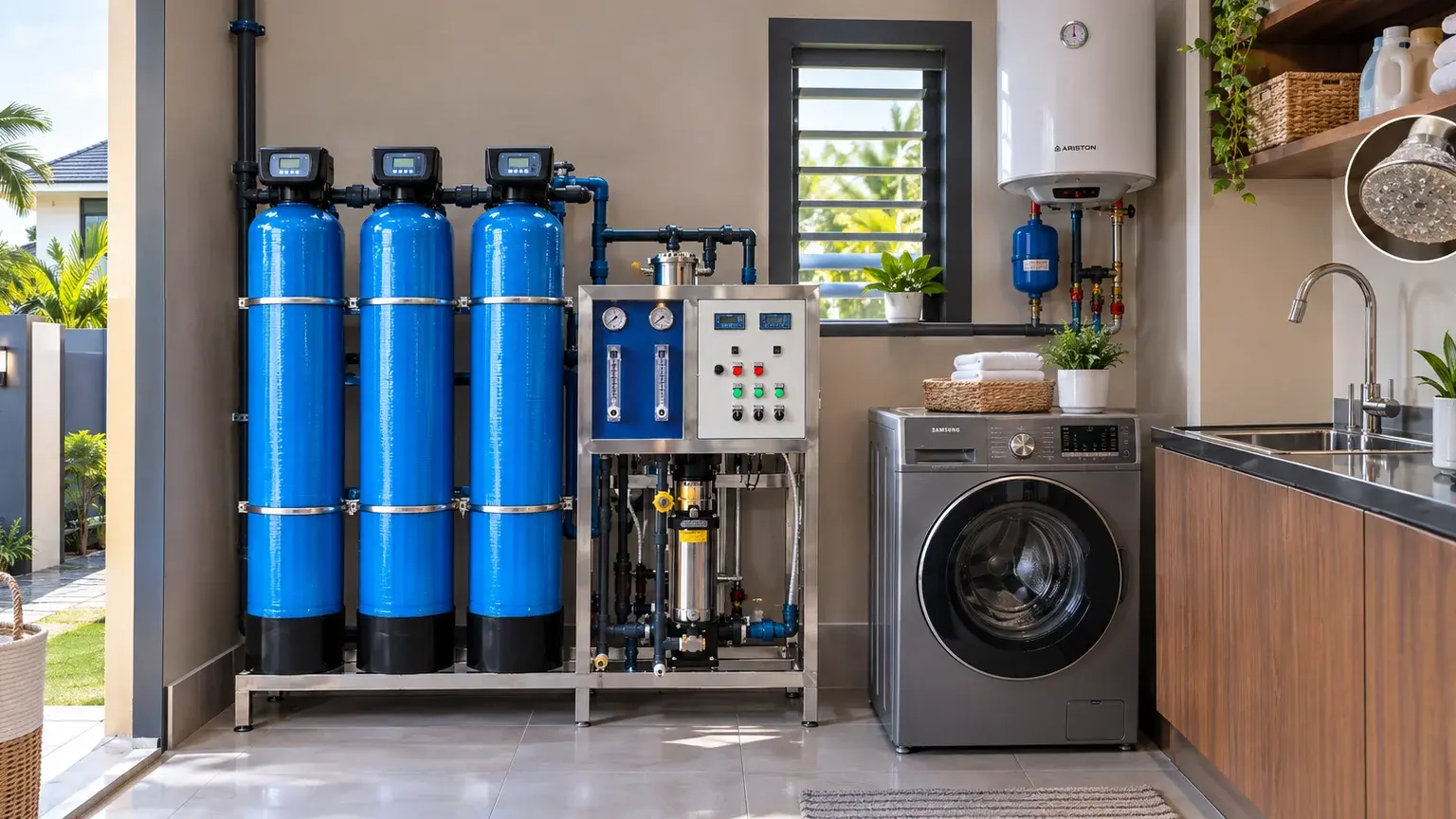
This is where whole-house or point-of-entry (POE) filtration becomes relevant.
A point-of-entry system is installed along the main water supply so that treated water can flow to multiple outlets throughout the home.
iClear's current whole-house guidance specifically describes POE filtration as treating water before it reaches showers, faucets, washing machines and water heaters.
The important qualification is that the type of treatment matters.
A whole-house system should be selected according to the characteristics of the incoming water and the contaminants you are trying to address. Not every filter removes every type of contaminant, and a sediment filter should not be assumed to solve a hardness or dissolved-mineral problem.
That is why water testing should come before choosing a whole-house setup where possible.
Does an RO Purifier Protect the Whole House?
No.
A typical under-sink RO purifier is a point-of-use system. It treats water at a specific connection, generally for drinking and cooking.
This makes it different from a whole-house system.
For example, an under-sink purifier can provide purified drinking water at the kitchen tap while the water going to your washing machine, shower and water heater remains untreated.
iClear's residential products include Standard and Premier RO purifiers intended for household drinking-water purification.
So if the main problem is water quality throughout the property, an under-sink purifier alone may not address it.
Whole-House or Under-Sink: Which One Do You Need?
The simplest way to think about the choice is to ask what you are trying to protect.
Choose a point-of-use purifier when:
- Your main priority is drinking and cooking water.
- You want purified water at a specific kitchen outlet.
- The rest of the household water does not require the same treatment.
Consider whole-house treatment when:
- You are concerned about water reaching multiple outlets.
- You see recurring sediment, staining or scale throughout the property.
- You want treatment before water reaches showers and appliances.
- Your water test indicates a problem that should be addressed at the point of entry.
In some homes, both approaches can make sense: whole-house treatment for the broader water supply and a dedicated RO purifier for drinking and cooking water.
How Do You Know If Your Home Has Hard Water?
Look for clues, but don't rely on them alone.
Scale around taps, showerheads, kettles and bathroom surfaces can indicate mineral buildup. However, these signs cannot tell you precisely how hard your water is or what other substances may be present.
Testing gives you a clearer starting point.
This is especially useful for homes relying on borehole or tanker water, where water characteristics can vary. iClear's water-testing guidance covers parameters including TDS, pH, iron, hardness, colour, turbidity and odour.
Protecting Your Home Starts With Understanding the Water
If you are spending money replacing showerheads, cleaning scale from kettles or servicing water-contact appliances more frequently than expected, it may be worth looking at the water itself.
The goal isn't to install the biggest filtration system available. It is to identify what is actually in your water and choose treatment that addresses the problem.
For drinking and cooking, a point-of-use RO purifier may be appropriate. For water-quality issues affecting multiple parts of the home, whole-house filtration may be the better starting point.
And where both needs exist, the two approaches can complement each other.
Before investing, test the water, identify the problem and then choose the treatment.
You can explore iClear's home water purification options or learn more about whole-house and under-sink filtration.
FAQs
Q: Can borehole water damage household appliances?
A: Depending on its chemistry, borehole water can contribute to sediment buildup, scaling, corrosion or staining in water-contact equipment.
Q: Does hard water damage washing machines?
A: Mineral scale can accumulate on components and affect efficiency over time.
Q: Can a whole-house filter protect appliances?
A: Point-of-entry treatment can reduce specific contaminants before water reaches showers, appliances and other outlets, depending on the system design.
Q: Does RO protect the whole house?
A: A typical under-sink RO purifier treats drinking water at one point; it does not replace whole-house treatment.
Q: How do I know if my home has hard water?
A: Common clues include scale on taps, showerheads, kettles and bathroom surfaces, but testing provides a more reliable assessment.
Q: Should I install whole-house filtration or an under-sink purifier?
A: The choice depends on whether your priority is protecting the entire plumbing system or treating drinking and cooking water.