


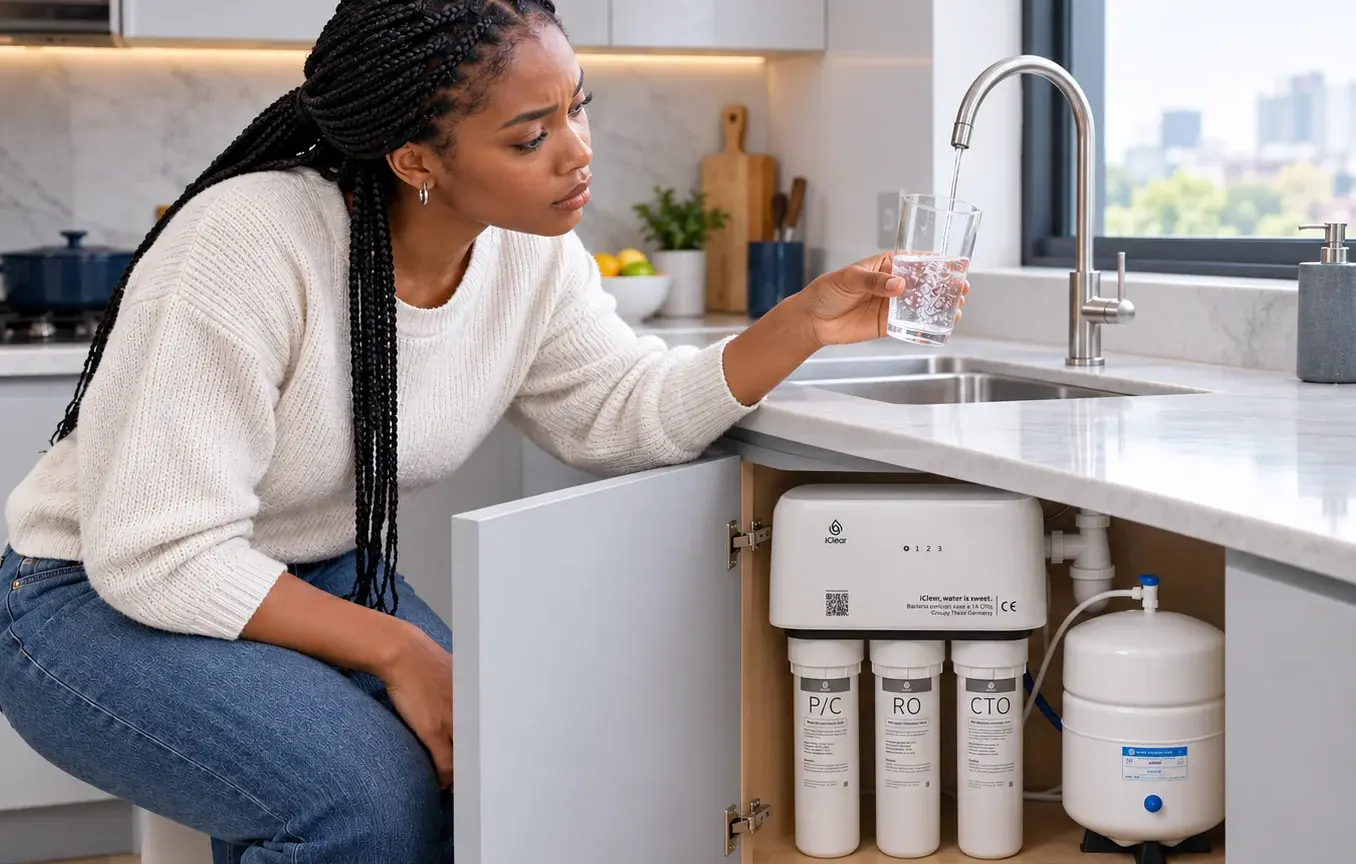
A water purifier that once filled a glass quickly may suddenly take much longer to produce the same amount of water. You might notice that the tap runs slowly, the storage tank takes longer to refill, or there is simply less purified water available throughout the day.
If you use a point-of-use reverse osmosis (RO) purifier at home, reduced output can have several possible causes. Some are related to routine maintenance, while others involve water pressure or internal components.
Before assuming that your purifier needs replacing, here are some things to check.
1. Check When the Filters Were Last Replaced
One of the first things to investigate is the condition and service age of your filters.
Pre-filters help capture sediment and other material before water reaches the RO membrane. Over time, the material they collect can restrict water flow. As a cartridge approaches the end of its recommended service life, reduced output may become noticeable.
If your purifier has not been serviced according to its recommended schedule, a clogged filter could be contributing to the problem.
What to do:
- Check your last filter replacement date.
- Review the manufacturer's recommended service intervals.
- Look for any available service records.
- Arrange an inspection if the filters are overdue or you are unsure of their condition.
Avoid replacing every cartridge simply because output has slowed. The aim is to identify which component needs attention.
For more guidance, read How to Maintain Your Water Purifier for Long-Term Performance.
2. Check the Water Supply and Inlet Pressure
Your purifier needs an adequate supply of incoming water to operate properly.
If the water pressure entering the system is too low, an RO purifier may produce water more slowly than usual. This can happen when the household supply is inconsistent, a pump is not operating as expected, or there is a restriction in the water supply line.
Pressure requirements vary between purifier models, so the correct operating range should be confirmed from the manufacturer's guidance.
What to do:
- Check whether other taps in the house also have weak water flow.
- Confirm that the household water supply is available.
- If your purifier uses a booster pump, check whether it appears to be operating normally.
- Contact a technician if you suspect a pressure-related problem.
Do not attempt to adjust internal pressure settings without the appropriate technical guidance.
3. Make Sure the Valves Are Fully Open
Sometimes, reduced output has a simple explanation: a valve is not fully open.
A partially closed inlet valve can restrict the amount of water reaching the purifier. A valve connected to the storage tank or dispensing line may also affect how much water reaches the tap.
If the purifier was recently moved, serviced or installed, it is worth checking whether a valve was accidentally left partially closed.
What to do:
Check the accessible external valves and confirm that they are in their normal operating positions. If you are unsure which valve controls the water supply, consult the installation guide or contact the installer.
Do not force a stiff valve or disconnect any pipework to investigate.
4. Consider the Storage Tank
Some point-of-use RO purifiers use a storage tank to hold treated water before it is dispensed.
If the tank is not filling properly, you may notice reduced water availability even when the purifier is still operating. A tank that has lost its air charge, where applicable, or has a faulty valve can also affect dispensing.
This can sometimes make the problem seem like a slow purifier when the actual issue is with water storage or delivery.
What to do:
- Check whether the tank appears to be filling normally.
- Observe whether the dispensing problem continues after the system has had time to replenish its supply.
- Look for visible leaks around accessible connections.
- Arrange a technician's inspection if the tank does not seem to fill or dispense correctly.
Tank pressure and internal components should be checked by someone qualified to service the system.
5. Could the RO Membrane Be the Problem?
If the pre-filters, water supply and accessible valves appear normal, the RO membrane may need attention.
The membrane is an important part of the reverse osmosis process. Over time, accumulated material and operating conditions can affect its performance. A fouled membrane may reduce the rate at which purified water is produced.
However, slow output alone does not confirm that the membrane is faulty. Other issues, including low inlet pressure and clogged pre-filters, can produce similar symptoms.
A technician can assess the system and determine whether the membrane needs cleaning, replacement or further investigation.
6. Should You Replace Every Filter When Output Slows?
Not necessarily.
Replacing every filter without identifying the cause can lead to unnecessary maintenance costs. Reduced output may be caused by a single clogged cartridge, a pressure problem, a faulty valve, a storage tank issue or the RO membrane.
A proper assessment helps establish which component is responsible.
You can also learn more about the differences between iClear's available systems in iClear Standard vs. Premier Purifier: A Comparison.
7. When Should You Call a Water Purifier Technician?
Basic checks can help identify obvious issues, but some problems require professional attention.
Arrange a service inspection if:
- Water output drops suddenly or becomes extremely slow.
- The purifier continues producing very little water after basic checks.
- You notice leaks around the unit.
- The system makes unusual sounds.
- The storage tank does not fill or dispense as expected.
- You suspect a membrane, pump or internal pressure problem.
Avoid opening pressurised components, disconnecting internal tubing or attempting to repair electrical parts yourself.
Keep Your Purifier Producing Water Reliably
Reduced water output does not automatically mean your purifier has reached the end of its useful life. It may simply need routine maintenance or attention to a particular component.
Start with the filter service history, check the accessible water supply and valves, and pay attention to how the storage tank behaves. If the cause is not obvious, let a qualified technician inspect the system before replacing parts.
At iClear, we provide water purification solutions and support to help households manage their water needs. If your purifier is producing less water than usual, contact our team for guidance on the next step.
Call or WhatsApp iClear: +234-708-063-7319
Frequently Asked Questions
Q: Why has my water purifier's output become slow?
A: Possible causes include clogged pre-filters, a fouled membrane, low feed pressure, a partially closed valve or a problem with the storage tank.
Q: Can a clogged filter reduce water flow?
A: Yes. Sediment and other captured material can restrict flow as a cartridge reaches the end of its service life.
Q: Can low water pressure affect purifier output?
A: Yes. Systems that rely on pressure may produce water more slowly when inlet pressure is below the manufacturer's operating range.
Q: Does a full or faulty storage tank affect dispensing?
A: Yes. A tank that is not filling correctly, has lost its air charge where applicable, or has a faulty valve can affect the amount of water available at the tap.
Q: Should I replace every filter when water production slows?
A: Not automatically. Check the service schedule and have the system assessed to identify whether a cartridge, membrane, pressure issue or component is responsible.
Q: When should I call a technician?
A: Seek service if output drops suddenly, the system leaks, makes unusual sounds or continues producing very little water after basic checks.