


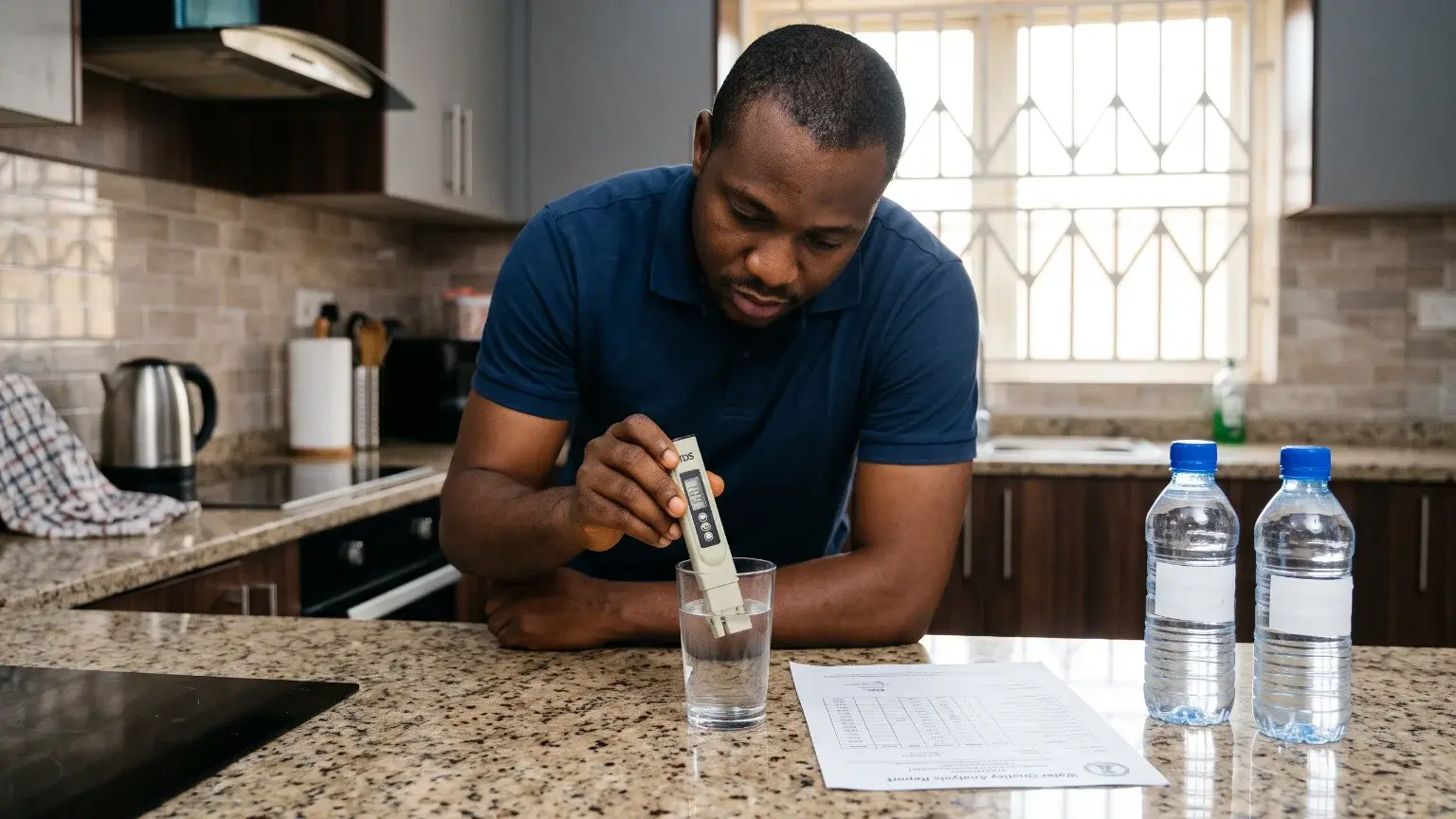
If you use borehole water at home, you may have come across a handheld TDS meter. These small, inexpensive devices are often used to check water by dipping a probe into a glass or container and reading a number on the screen.
The reading can be useful, but what does it actually mean? Can it tell you whether your borehole water is safe to drink? And is it enough to help you choose a water purifier?
Understanding the difference between a TDS meter and a laboratory water test can help you avoid making decisions based on a single number.
What Does a Handheld TDS Meter Measure?
TDS stands for Total Dissolved Solids. It refers to the combined amount of dissolved substances in water, including minerals and salts.
Most inexpensive handheld TDS meters do not directly identify or measure every dissolved substance. Instead, they measure the water's electrical conductivity and convert that reading into an approximate TDS value, usually displayed in parts per million (ppm).
Because dissolved ions help water conduct electricity, the reading provides an indication of the concentration of ionic substances present.
For a homeowner, this can be useful when comparing water samples or checking whether a reading changes over time. For example, you could compare readings from your borehole, storage tank and treated water.
However, the number does not tell you exactly what is dissolved in the water.
What a TDS Meter Can and Cannot Tell You
A TDS meter is useful for a quick indication of dissolved ionic content. It is not a complete water-quality testing device.
What it can help you do:
- Get an approximate TDS reading.
- Compare readings from different water sources.
- Observe changes in dissolved-solids readings over time.
- Make a rough before-and-after comparison when checking an RO purifier.
What it cannot tell you:
- Whether water contains harmful bacteria or viruses.
- Which specific minerals, salts or metals are present.
- Whether a particular chemical contaminant is present.
- Whether the water is safe to drink.
- Whether all contaminants have been removed by a purifier.
This distinction matters because water can have a low TDS reading and still contain contaminants that do not significantly affect electrical conductivity. A high reading also does not identify the substances responsible.
A single TDS number should therefore not be treated as a safety certificate.
TDS Meter vs. Laboratory Water Test: What's the Difference?
The main difference is the level of information each method provides.
|
Handheld TDS meter |
Laboratory water test |
|
Provides an approximate TDS reading |
Can test for selected individual parameters |
|
Measures electrical conductivity and converts it to an estimated TDS value |
Uses appropriate analytical methods for the parameters requested |
|
Quick and convenient for routine comparisons |
Provides more detailed information about the tested sample |
|
Does not identify individual contaminants |
Can identify specific chemical or microbiological contaminants included in the test |
|
Cannot establish drinking-water safety |
Can support a more informed assessment when the right tests are selected |
A laboratory test is not automatically comprehensive. The results depend on which parameters are requested, how the sample is collected and handled, and the methods used.
For borehole-dependent homes in Lagos, Abuja and other parts of Nigeria, laboratory testing may be particularly useful when investigating an unusual taste, colour, odour or change in water quality.
Is a TDS Meter the Same as a pH Meter?
No. They measure different things.
A TDS meter estimates dissolved ionic content, while a pH meter measures how acidic or alkaline water is.
Both readings can contribute to an initial understanding of water quality, but neither independently confirms that water is safe to drink.
Other parameters may also need to be investigated, depending on the water source and the reason for testing. These can include hardness, iron, turbidity, nitrates and microbiological indicators.
This is why checking only TDS and pH may leave important questions unanswered.
When Should You Get a Laboratory Water Test?
A laboratory test is worth considering when you need more information than a handheld meter can provide.
For example, consider arranging appropriate laboratory testing when:
- You are assessing a new borehole before relying on it as a household water source.
- Your water develops an unusual taste, colour or smell.
- You notice a change in water quality that a TDS reading cannot explain.
- You want to investigate possible chemical or microbiological contamination.
- You are selecting a treatment system and need to understand which contaminants should be addressed.
The laboratory should test for parameters relevant to your water source and intended use. If microbiological contamination is a concern, ensure that appropriate microbiological tests are included.
Can a TDS Meter Check Whether Your RO Purifier Works?
It can provide a rough indication, but it should not be your only check.
You can take readings before and after an RO purifier and compare the results. A lower reading after treatment may indicate that the system has reduced dissolved-solids content.
However, this comparison does not verify the removal of every contaminant or establish that the treated water is safe to drink.
It is also important to use the meter correctly and compare readings under reasonably consistent conditions. For a more complete assessment, appropriate water testing is still necessary.
What Should You Do If Your TDS Reading Is High?
Do not rush to buy a purifier based on the reading alone.
A high TDS result indicates that the water has an elevated estimated dissolved-solids level. It does not explain which substances are responsible or what treatment is required.
The more useful next step is to investigate the water through suitable testing. Once you understand the results, you can consider a treatment system that addresses the identified water-quality concerns and matches your household's daily demand.
At iClear, home water assessments cover parameters such as TDS, pH, iron, hardness, colour, turbidity and odour. These checks can help provide an initial understanding of your water and inform the next steps. Where specific chemical or microbiological contaminants need to be identified, additional laboratory testing may be required.
Before choosing a water purifier, understand the water you are treating. Speak with iClear about a home water assessment and the available purification options.
Call or WhatsApp: +234-708-063-7319
Frequently Asked Questions
Q: What does a handheld TDS meter measure?
A: It estimates dissolved ionic content by measuring electrical conductivity and converting that reading into an approximate TDS value.
Q: Can a TDS meter tell me if water is safe to drink?
A: No. A low reading does not rule out bacteria, viruses or contaminants that do not significantly affect conductivity. A high reading does not identify the substances present.
Q: Is a TDS meter the same as a pH meter?
A: No. A TDS meter estimates dissolved ionic content, while a pH meter measures acidity or alkalinity.
Q: When should I use a laboratory water test?
A: Use appropriate laboratory testing to identify specific chemical or microbiological contaminants, investigate a change in water quality or select treatment confidently.
Q: Can I use a TDS meter to check whether my RO purifier works?
A: A before-and-after comparison can provide a rough indication of dissolved-solids reduction, but it does not verify every contaminant or certify water safety.
Q: What should I do if my TDS reading is high?
A: Treat it as a reason to investigate, not a diagnosis. Arrange suitable testing to identify the dissolved substances before choosing treatment.