


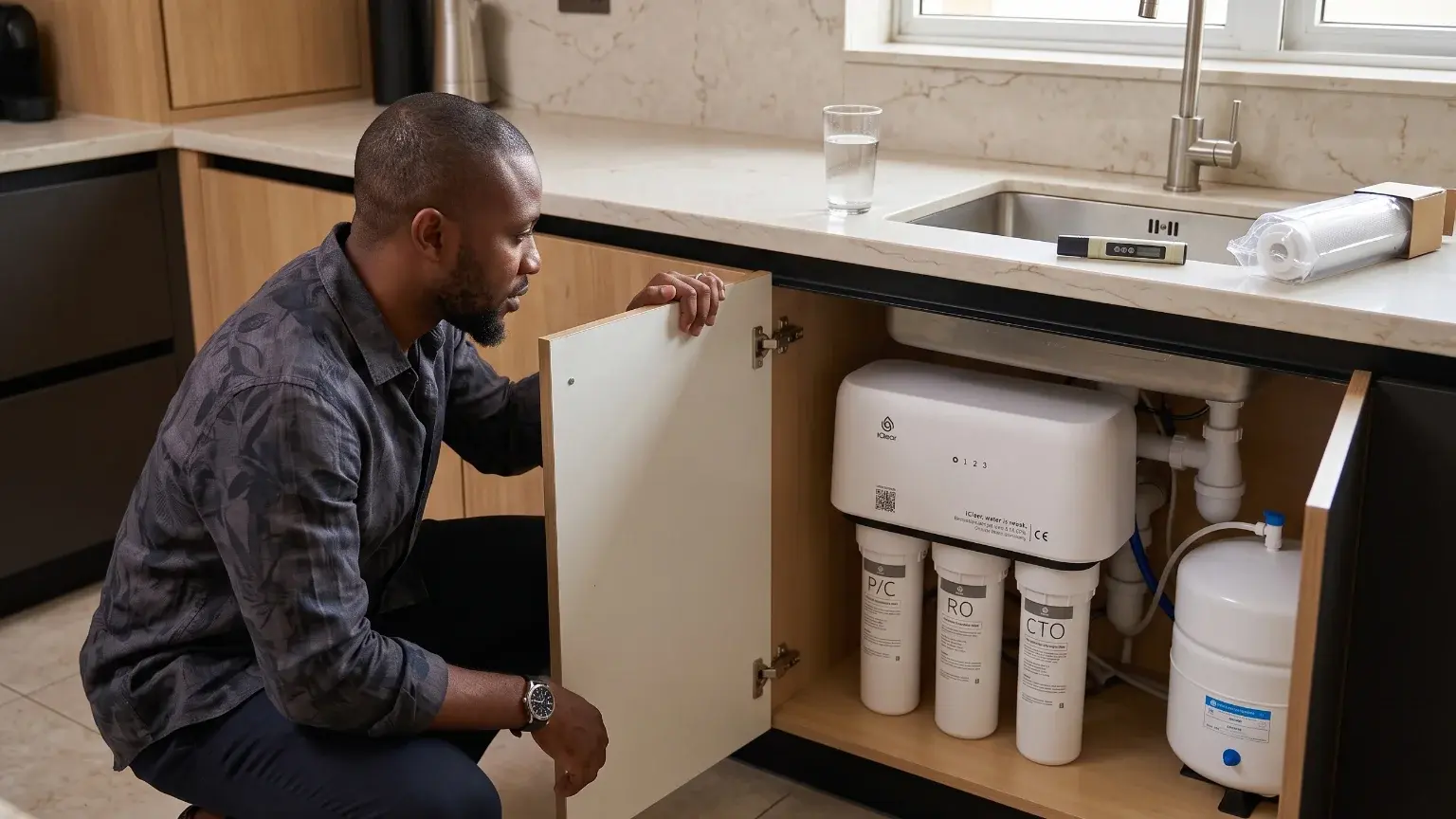
Buying a water purifier should start with your water, not the product price.
Before choosing a system, you need to understand your water source, the treatment it may require, how much purified water your household uses and what it will take to maintain the purifier over time.
That matters because the right system for one Nigerian home may not be the right choice for another.
Use this checklist before you buy.
1. Know Your Water Source
Start with the basics: Where does your household water come from?
It could be borehole water, tanker-supplied water, municipal water or a combination of sources. Different sources can have different water-quality characteristics, so choosing a purifier simply because it is popular may not give you the right treatment.
If you are unsure about your water quality, consider testing it before choosing a system.
iClear's home water assessment looks at parameters including TDS, pH, iron, hardness, colour, turbidity and odour.
This gives you a better starting point than relying only on how the water looks or tastes.
2. Identify What Your Water Needs
Once you understand the source, consider what the purifier actually needs to address.
Ask the supplier:
- What purification technology does the system use?
- What is it designed to reduce?
- Is it intended for drinking water or broader household use?
- Does the water require pre-filtration?
- Is Reverse Osmosis (RO) appropriate?
Different purification technologies serve different purposes. iClear's residential range includes RO-based household purifiers, while its Desktop Purifier provides a compact purification and dispensing option without plumbing.
The important thing is to match the technology to the water and how you intend to use it.
For more on water testing, see iClear's guide to testing borehole water quality at home.
3. Choose Capacity Based on Household Demand
House size alone does not tell you how much purified water you need.
Think about:
- Number of people in the household
- Drinking and cooking habits
- Frequency of guests
- Storage capacity
- Peak periods of use
For example, iClear's Standard Purifier is listed at up to 4,000 litres per filter cycle, while the Premier is listed at up to 7,200 litres per cycle.
The important question is not simply which number is bigger. It is whether the purifier's capacity fits your household's actual demand.
If you're choosing a system for a 2-, 3-, 4- or 5-bedroom home, remember that bedroom count is only a starting point. Household size and water consumption matter more. See the guide on choosing a purifier for a Nigerian home by household size.
4. Decide Whether You Need Point-of-Use or Whole-House Treatment
This distinction can prevent you from buying the wrong type of system.
A point-of-use purifier treats water at a specific outlet, such as a kitchen tap. This can make sense when your main priority is purified water for drinking and cooking.
A whole-house or point-of-entry system treats water before it reaches multiple outlets around the property, including showers and appliances.
These systems are not necessarily alternatives. Some homes may need whole-house treatment for general household water while using a separate point-of-use system for drinking water.
Read more about the difference in iClear's whole-house water filtration guide.
5. Check Installation Requirements Before Buying
A purifier may look suitable on paper but still be impractical for your available space or plumbing setup.
Before paying, ask:
- Does it require plumbing?
- Where can it be installed?
- Is a storage tank included?
- Is installation included in the quoted price?
- Are additional fittings or pre-filters required?
For example, iClear's Standard and Premier household systems currently include an additional tank and tap.
Also consider whether you have enough space for the purifier and any associated components.
6. Calculate the Ongoing Cost
The purchase price is only part of the cost of owning a purifier.
Ask about:
- Filter replacement intervals
- Replacement-filter prices
- Availability of genuine filters
- Routine maintenance
- Servicing costs
- Power requirements
Filter replacement can depend on the purifier, water quality and usage, so avoid assuming that every household will follow the same schedule.
A lower purchase price may not represent better value if replacement parts are expensive or difficult to obtain.
iClear's water purifier cost and maintenance guide covers some of these ongoing considerations.
7. Consider Power and Everyday Use
If the purifier uses electricity, understand its power requirements before installation.
Ask whether it works with your existing inverter or generator and what happens when there is a power outage.
For Nigerian households where electricity availability varies, this can be an important practical consideration.
You can also review iClear's guide to water purifier inverter and generator requirements.
8. Check Warranty and After-Sales Support
Finally, look beyond the product itself.
Before buying, find out:
- What does the warranty cover?
- How long does it last?
- Who handles servicing?
- Are replacement filters available?
- How are service requests handled?
A water purifier requires ongoing maintenance, so reliable after-sales support can be an important part of the buying decision.
Your Water Purifier Buying Checklist
Before placing your order, make sure you can answer these questions:
☐ What is my water source?
☐ Have I tested the water?
☐ What water-quality issues need to be addressed?
☐ Which purification technology is appropriate?
☐ How much purified water does my household need?
☐ Do I need point-of-use or whole-house treatment?
☐ Where will the system be installed?
☐ What does installation include?
☐ How often will filters need replacing?
☐ How much do replacement filters cost?
☐ Are genuine replacement filters available?
☐ What maintenance does the system require?
☐ What are its power requirements?
☐ What warranty is included?
☐ Who provides after-sales support?
The best water purifier is not necessarily the most expensive one. It is the system that matches your water quality, household demand, installation requirements and ability to maintain it.
If you're unsure where to start, start with the water. An assessment can help you understand what treatment your home actually needs before you commit to a system.
You can request an iClear home water assessment or explore the available iClear purification systems.
FAQs
Q: What is the first thing to check before buying a water purifier?
A: Start with the water source and test the water where possible. The purifier should be selected around the contaminants and usage requirements.
Q: Should I know my TDS before buying an RO purifier?
A: TDS is useful, but it is only one water-quality indicator. Other parameters may be needed to understand the complete treatment requirement.
Q: What questions should I ask a water purifier supplier?
A: Ask about technology, capacity, installation, filter replacement intervals, replacement-filter availability, warranty, servicing and what contaminants the system is designed to reduce.
Q: Is a cheap water filter always cheaper in the long run?
A: Not necessarily. Purchase price should be considered alongside installation, replacement filters, maintenance, power requirements and system lifespan.
Q: Do I need a whole-house filter and an RO purifier?
A: Some homes may benefit from both because whole-house and point-of-use systems solve different problems, but the need should be based on the water assessment.
Q: Can iClear help me choose a purifier?
A: iClear provides home water assessments and a range of purification systems designed for different household water conditions and use cases.